


Voltage Converters & Transformers
Traveling to Fiji with electrical appliances?
Check the local voltage and frequency to find out whether you may need a voltage converter or transformer.
Electrical Supply Specifications
The US mains supply is specified as 120 V ±5%, 60 Hz
Mains Supply in Fiji


Compatibility results are based on nominal mains supply specifications.
Always check the voltage and frequency ratings printed on your appliance before connecting it.
Do You Need a Voltage Converter?

It's important to understand that travel plug adapters generally only convert the shape of a plug into a configuration that will physically fit a foreign outlet. The majority do not convert the mains supply voltage. Those that do will say so explicitly.
Appliances That Do Not Require Voltage Conversion
Multi-voltage appliances are designed to operate safely on a range of voltages commonly found around the world. These will normally be marked 100-240 V 50/60 Hz or similar.
Many travel electronics and gadgets fall into this category including:
- Most phones, tablets, other handheld devices and their chargers
- Most camera chargers
- Many (but not all) laptop chargers
- Some (but not all) of the lower-powered hair tools such as straighteners

Switchable Dual-Voltage Appliances
Some dual-voltage appliances may be marked 120/230 V and have a switch enabling the user to select the appropriate voltage setting depending upon the local mains supply. Care must be taken to ensure that the correct selection is made before plugging such an appliance in as it can be dangerous to try and operate a 120 V item on a 230 V supply.
Appliances That Do Require Voltage Conversion
US nominal voltage is defined as 120 V with a supply tolerance of ±5% (114 - 126 V). Some countries operate a mains supply that is below that range but many of those use 110 V. Many US appliances can also operate at 110V, although this depends on the manufacturer's specifications. The notable exception is Japan which runs on 100 V. While some US appliances may be tolerant of this, others will require a step-up transformer.
Of greater concern are countries that operate with a mains supply in the 220-240 V range (Europe, Australia, most of Asia & Africa and parts of the Middle East & South America). For these countries a suitable step-down converter or transformer may be needed.
A US single voltage appliance will be marked 120 V or similar. Appliances such as these should never be plugged into a mains socket that supplies 220-240 V. It is dangerous and can result in damage to the equipment, injury and fire.

Examples of appliances that may be single-voltage include:
- Some (but not all) hair tools, such as hair dryers, straighteners and the like
- Appliances that produce significant heat such as kettles & irons
- Some older PCs and power supplies
- Most power tools
- Large appliances such as washing machines, fridges etc.
Check the label of individual appliances to be sure.
In order to determine if you need a voltage converter or transformer you will need to check the supply voltage in your destination country and the voltage specification of any appliance that you wish to use.
If voltage conversion is required you will need either a step-up or step-down converter or transformer, depending on the destination's supply voltage.
Take particular care when checking the voltage requirements of critical equipment, particularly medical devices.
Voltage Converter vs Transformer
| Features | Electronic Voltage Converter | Transformer |
|---|---|---|
| Technology | Solid state | Electromagnetic induction |
| Output Waveform | Often non-sine-wave (chopped) | Input sine wave is generally preserved |
| Power Type | Typically designed for particular AC loads; output characteristics vary | AC input and output |
| Usage Duration | Generally for short-term or intermittent use | Can support continuous use |
| Suitability | Depends on the converter design and approved appliance types | Suitable for compatible AC loads within its ratings, including some motors and electronics |
| Portability | Lightweight and compact | Heavy and bulky |
| Cost | Usually cheaper | More expensive |
As a general rule of thumb voltage converters are preferred for travel, where they are compatible, as they are lighter, cheaper and more compact. However, for compatible sensitive electronics, high-powered appliances or equipment that needs to run continuously for extended periods, a suitably rated transformer may be the better option.
Always check that any voltage converter or transformer is compatible with and has a sufficient power rating for the appliance that you want to connect.
If you have critical equipment, such as medical devices, consult the manufacturer to ensure that you select a voltage converter or transformer that is both suitable and also of the correct rating for the appliance.
Selecting the Right Voltage Converter or Transformer
Once you have made a decision that you need a voltage converter or transformer it is important to select one that meets the power requirements of any appliance that you want to connect to it.
When selecting a high-powered voltage converter or transformer, remember that the maximum power available will also be limited by the current rating of the mains outlet and any plug adapter used.

Check the appliance's power requirements, usually stated in watts (W) or amps (A). For simple resistive loads, watts can be calculated using the formula Watts = Volts x Amps. Transformers may instead be rated in volt-amperes (VA) or kilovolt-amperes (kVA), which are not necessarily equivalent to watts for all AC appliances.
For appliances without significant startup surges, a rule of thumb is to select a unit with a power rating that is 25–50% higher than the appliance's stated power requirements, using comparable ratings, in order to provide a reasonable safety margin.

Some appliances have startup surges, during which they draw more current than in continuous operation. Appliances with motors, compressors and sometimes heaters can fall into this category. Under these circumstances you can require a voltage converter or transformer that is rated at 2-3 times, or more, the stated power consumption of the appliance being used. While most travel devices don't fall into this category detailed research can be required if you have critical equipment and we would advise contacting the manufacturer of the equipment as getting the specification correct can be tricky.
Choose a converter or transformer rated for the appliance's continuous power requirements and any startup surge, following the manufacturer's instructions. Check whether the rating is specified in watts or volt-amperes (VA), and whether the equipment is approved for continuous operation.
Some transformers come fitted with extra features such as circuit breakers, overload protection and thermal shutdown for safety.
Size and Weight
A significant limitation of transformers, for travelers, is that they can be bulky and heavy.
While a compact 200 W voltage converter may be a little bigger than a plug adapter and weigh around 12-18 oz, a 2000 W transformer could be closer to the size of a shoebox and weigh 10-15 lb or more.
Frequency 50 Hz vs 60 Hz
The US mains supply operates at 60 Hz, which is common across North & Central America and parts of South America, the Middle East & Asia. In Europe, Asia, Africa, Australia and parts of South America and the Middle East 50 Hz supplies are common. Most modern travel electronics are designed to work at either frequency and will be marked 50/60 Hz. However, some appliances containing motors, clocks and other frequency-sensitive equipment may not operate correctly at 50 Hz. Check the frequency rating on your device before use; if it is marked 50/60 Hz, it is suitable for either frequency, as long as it's compatible with the supply voltage. If you are unsure, particularly with specialist or medical equipment, check with the manufacturer.
Standard voltage converters and transformers only change the voltage, not the frequency, of the supply. Changing the frequency requires specialist frequency-conversion equipment, which is not normally practical for travelers.
Practical Advice on Using Electrical Appliances Abroad
Bathroom Shaver Outlets
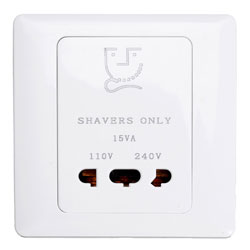
Some hotels, particularly in Europe, provide bathroom shaver outlets with a choice of two output voltages, typically 115 V and 230 V.
These outlets are designed for low-powered appliances such as electric shavers. Always check the maximum power rating marked on the outlet before connecting an appliance.
Never connect high-powered appliances such as hair dryers, or voltage converters or transformers, to a bathroom shaver outlet.
Surge Protectors and UPS Units
Surge protectors, including those incorporated into power strips, are designed to operate at specific mains voltages. Connecting a surge protector to a higher voltage than it is designed for can cause overheating, equipment damage or fire.
Uninterruptible power supplies (UPS) may also have specific voltage, frequency and grounding requirements.
Do not assume that using a voltage converter or transformer makes these devices compatible with a foreign electrical supply. Always check the manufacturer's recommendations.
Grounding and Electrical Safety
If your appliance requires a grounded connection, ensure that any travel plug adapter, voltage converter or transformer maintains that connection to a suitably grounded mains outlet.
Not all voltage transformers provide electrical isolation, and voltage conversion does not in itself provide protection against electric shock.
Always use equipment that is suitable for the appliance being connected and follow the manufacturer's safety instructions.
FAQs
Voltage Converters & Transformers
-
No. Travel plug adapters change the shape of your plug to fit a foreign socket but most do not change the voltage of the mains supply. Combined voltage converters and plug adapters do exist but they aren't common and will explicitly say that they convert voltage.
-
A voltage converter changes the voltage of the mains supply, often using solid-state electronics, allowing compatible electrical appliances to operate on a supply voltage that would otherwise be unsuitable.
Voltage converters can be either step-up (eg 120 V -> 230 V) or step-down (eg 230 V -> 120 V). Electronic travel voltage converters are generally lightweight and compact, making them convenient for use with compatible travel appliances. -
An electrical transformer uses electromagnetic induction to change the voltage of an AC electrical supply, allowing compatible electrical appliances to operate on a supply voltage that would otherwise be unsuitable.
Transformers can be either step-up (eg 120 V -> 230 V) or step-down (eg 230 V -> 120 V). They are generally heavier and bulkier than electronic travel voltage converters but may be better suited to continuous operation, high-powered appliances and some sensitive electronics, provided they are compatible and correctly rated. -
Most modern phone and laptop chargers are designed to operate on mains supplies ranging from 100 to 240 V at either 50 or 60 Hz. If your charger is marked 100–240 V, 50/60 Hz, you will not normally need a voltage converter, although you may need a travel plug adapter.
Always check the input voltage and frequency ratings printed on your charger before using it abroad. -
The European mains supply is 230 V, which is significantly higher than the US (120 V). Multi-voltage devices that are marked 100-240 V or similar will not require a voltage converter.
Single-voltage appliances marked 120 V or similar will require a compatible, correctly rated step-down voltage converter or transformer. It is dangerous to plug these directly into the 230 V in Europe and may result in damage to your equipment, fire or injury.
You may also need a plug adapter, and you should check that your appliance is compatible with the local 50 Hz supply. -
The UK mains supply is 230 V, which is significantly higher than the US (120 V). Multi-voltage devices that are marked 100-240 V or similar will not require a voltage converter.
Single-voltage appliances marked 120 V or similar will require a compatible, correctly rated step-down voltage converter or transformer. It is dangerous to plug these directly into the 230 V in the UK and may result in damage to your equipment, fire or injury.
You may also need a plug adapter, and you should check that your appliance is compatible with the local 50 Hz supply. -
Some voltage converters are specifically designed for use with hair dryers, but not all converters are suitable. Hair dryers typically consume between 1000 and 2000 W, and models with electronic controls may have additional compatibility requirements.
A suitably rated transformer may be an alternative, but transformers capable of handling these power levels are generally bulky, heavy and expensive (sometimes costing more than the hair dryer).
A more practical solution is often to buy a dual-voltage travel hair dryer or an inexpensive hair dryer locally. Always check the manufacturer's recommendations before using a voltage converter with a hair dryer.
See our hair tools page for more information. -
No. Transformers only change the supply voltage, not the frequency. Many travel gadgets will be marked 50/60 Hz and will work at either frequency, provided the supply voltage is also compatible.
Changing the frequency requires specialist frequency-conversion equipment, which is not normally practical for travelers.