Voltage Converters / Transformers
Product recommendations are temporarily unavailable.
This page contains general information for international travellers. For country-specific recommendations, please visit our dedicated UK or US pages below.
Looking for suitable transformers?
We have dedicated pages with local pricing and shipping:

Prices in £, UK stock and delivery

Prices in $, USA stock and delivery
Or stay on this page for general information.
Transformers & Voltage Converters
So you've found yourself a suitable travel adaptor that will allow you to plug all of your devices into the sockets in the country that you are about to visit - job done right? Unfortunately life's not quite that simple. Travel adaptors will allow you to physically plug your devices into a socket that it was not designed to fit. Useful, but that's all it does - travel adaptors do not change the voltage or frequency of the mains supply, at least the vast majority don't.
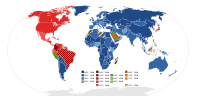
Outside of Central & North America, which rune on 120V 60Hz, and Japan (100V) the majority of the world's electrical systems run on 230V 50Hz. When you are travelling abroad you will need to check your electrical devices / appliances to see if they are compatible with the local mains supply. Many travel appliances are dual voltage, take a laptop as an example, they are designed for portability and will often be marked (maybe on the power supply) 100 - 250V 50/60Hz. The same is often true of phone chargers, shavers and the like. If so these items can be used anywhere in the world without the need for a voltage converter or transformer. Single voltage devices that are incompatible with the local supply will require a voltage converter or transformer in order to operate safely.
If you plug a European hairdryer (designed to work on 230V) into a lower voltage US socket (120V) it is unlikely to work well, if at all, and you may damage it as well. If you plug an American hairdryer (designed to work on 120V) into a higher voltage European socket (230V) you can expect fireworks - very dangerous and not recommended.
If you need to take devices to an area where the mains supply is different to your domestic one you will need to get a transformer / converter to power any devices that are not fully compatible. Although these two terms are often used interchangably there are some important differences that you need to understand in order to ensure that you end up taking the right kit.
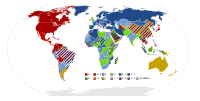
To check local voltages around the world you can look at our voltage map of the world. Alternatively we have more detailed informaion if you search by country.
Voltage Converters vs Transformers
These pieces of equipment "convert" voltage in different ways which in turn affects (amongst other things) what type of devices you can plug into them. Mains electricity is a sine wave - in Europe for instance (230V 50Hz supply) the voltage will rise smoothly from 0 - 230V then drop to negative 230V before rising back to 0V. This is one cycle of the sine wave which happens 50 times per second so the supply frequency is 50Hz.
In order for a transformer to change a 230V supply into 120V it reduces the amplitude of the sine wave by roughly half but it still remains a true sine wave. A voltage converter on the other hand effectively "chops" the peaks of the sine wave off. That results in a chopped wave that approximates 120V.
Electronic devices that have circuits and chips such as TVs, computers, chargers etc. require a power supply that is a true sine wave so you have to use a transformer to power them. Simple electric devices such as heaters and simple motors are more tolerant and can be run on the chopped waveform so you can use either a converter or a transformer.
Voltage Converters
International travellers may find a voltage converter useful when visiting countries that use a different supply voltage from their domestic one. Central & North America use 110V - 120V, Japan uses 100V and the majority of other countries use 220V - 240V. Popular holiday destinations like the UK, France, Italy and Spain will likely require a voltage converter for Europe.

Features:
- Usually cheaper
- Usually lighter as they are solid state (a 500w converter should weigh less than 0.5kg / 1lb)
- Can only power simple electric devices not electronics
- Cannot be used continuously for extended periods of time (more than about 3 hours)
You can pick up low powered (100W) converters very cheaply and they often take up no more space than a plug adaptor. When choosing a voltage converter however it is generally recommended to get one that is rated at 2 - 3 times the wattage of the appliance that you want to plug into it. That means that if you have a device that says it is 35w you should get a 100w converter to have a safe margin.
A word of caution: Many devices draw more power on start up than in normal use (see what we found out about hair straighteners) and you need to accomodate this. Converters are often a good choice for the traveller with one or two low powered electical devices that are not dual voltage.
Not sure if you need a voltage converter? Search by country
Transformers
International travellers may find a transformer useful if electronic devices (not just for charging phones / tablets etc) or medical quipment need to be powered and you are visiting a country with a different voltage to your domestic supply. North & Central America uses 110V - 120V, Japan uses 100V whilst Europe, Asia, South America and most of the rest of the world uses 220V - 250V.

Features:
- Can power both electric and electronic devices
- Can be used continuously for extended periods
- The power supply of choice for critical equipment eg medical devices
- More expensive than converters
- Bulky and heavy (a 1000w transformer can weigh 7 - 10kg / 15 - 20lbs)
When choosing a transformer it is necessary to get one that is rated at a wattage that is a minimum of 25% higher than the device that you are going to plug into it. Transformers should run happily for extended periods of time (overnight) at 80% of their rated capacity.
Many devices draw more power on start up than in normal use and you have to accomodate this so always build in as much margin as is practical and you can afford. For this reason it is generally recommended to get one that is rated at 150% or more the wattage of the appliance that you want to plug into it.
High powered transformers are generally not practical for travellers due to their size and weight. They may be the only option however if you have critical pieces of equipment that you absolutely have to take with you such as medical devices.
Not sure if you need a transformer? Search by country
Frequency
AC frequency refers to the number of cycles or times that the current reverses direction in a second. In the USA & Canada the supply frequency is 60 Hz whilst in the UK, Europe and most of the rest of the world it is 50 Hz. Voltage converters and transformers will only change the voltage, not the frequency. There is no practical way of altering the frequency of a supply.
If the country that you are going to operates at a different frequency it makes little practical difference as most travel appliances will run at either frequency. Some items with motors, such as hairdryers and some clocks will run at a slightly different speed than intended but it is not likely to be particularly problematic.
Check your device - it may say 50/60 Hz which indicates that it is compatible with either frequency. If you are in doubt or have critical or expensive equipment check with the manufacturer first as some equipment may be damaged by running on an incorrect frequency.
Practical Information
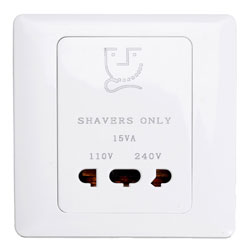
European Shaver Sockets
It is quite common to find these 110 / 220V shaver outlets in hotel bathrooms across Europe.
They are designed for low power devices such as shavers only (less than 15 watts). Do not plug in high powered accessories such as hair dryers as you will trip the circuit breaker and may damage the appliance.
You should never plug any voltage converter or transformer into these outlets.

Surge Protectors / UPS
Domestic surge protectors and UPS (Uninterruptible Power Supply) should not be used in countries with a different supply voltage. The network is set up differently and you may damage your equipment even when using a voltage converter or transformer.
This means that domestic power strips with integral surge protection should not be used with an incompatible mains supply. Instead you should purchase a suitable surge protected adaptor designed for the job if required. Where these are available we have specific recommendations if you search by country.
Japan
Japan operates on 100V which is lower than most countries. If you need to take a transformer with you be careful to check that it is capable of stepping up from 100V.
Frequently Asked Questions
About Voltage Converters / Transformers
-
What is a voltage converter?
-
A voltage or power converter is a compact and economical device that converts the electrical output of a socket by either increasing or decreasing its voltage. This is useful for international travellers as it can provide a different voltage from an overseas socket to the correct one for your domestic appliances. Due to the way in which they work (essentially providing a chopped DC output) they are suited to simple electric devices and are not generally suitable for powering most electronic items such as desktop computers.
-
What is a step up transformer?
-
A transformer converts the voltage of overseas sockets by either stepping it up (120V => 230V) or down (230V => 120V) that can be used to power your domestic devices abroad. As they provide true AC output they can be used to power electronic items as well as basic electric ones. They are heavy, bulky and expensive in comparison to voltage converters however so are generally not appropriate for travellers unless critical equipment (such as medical) needs to be powered.
-
How do I use a voltage converter / transformer?
-
Just plug the voltage converter or transformer into a wall socket and then plug your device into the converter / transformer. Transformers may have a selector switch or dedicated sockets for different voltage outputs.
-
Do I need a voltage converter for Europe?
-
International travellers to Europe may need a voltage converter or transformer if their domestic appliances are rated at 100V - 120V as the EU voltage is 230 V 50 Hz. You will need to check your equipment as many travel appliances are dual voltage, in which case they will be marked "100 - 240V" or similar and will operate safely. Some high powered items (eg hair dryers) are single voltage however and would require a voltage converter or transformer to operate safely. Travellers will need to check their individual appliances in order to verify if a voltage converter or transformer is required.
-
Do I need a voltage converter for {insert country}?
-
Use our search by country form on this page to check the local voltage in your destination and see if you need a voltage converter or transformer.
-
Do I need a voltage converter to charge my phone abroad?
-
No, you may need to select a plug adaptor with onboard USB or USB-C and the appropriate charging cable. USB charging ports usually work with input voltages of 100V - 250V so a voltage converter is not normally required specifically for charging your phone. If you are using a dedicated phone charger (as opposed to USB) you will need to check for voltage compatibility.
-
Can you take a voltage converter on a plane?
-
Yes, voltage converters and transformers can safely be taken in hand luggage or checked bags (due to their weight transformers may need to go in checked baggage). They do not contain batteries so present no danger.
Search Power Adaptors
by Country
| Useful Information | ||||||
|
||||||